
The short version
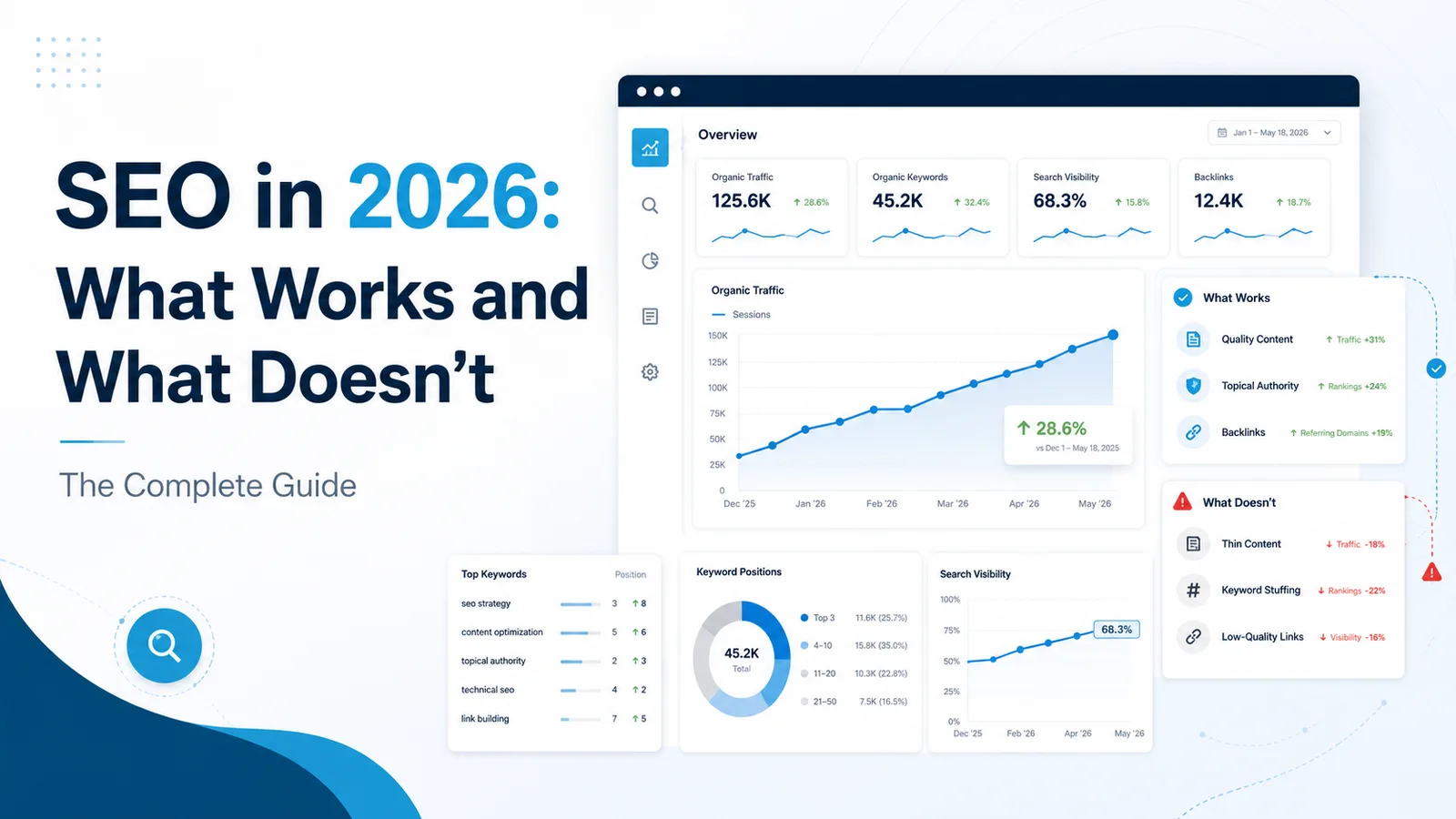
SEO isn't dying in 2026 — it's splitting in two. Everything built on authority, depth, and real editorial value is compounding. Everything built on volume, manipulation, and shortcuts is falling apart, faster every quarter. The clearest proof is a 100,000-page correlation study across 5,000 commercial keywords in 14 sectors (Visionary Marketing, Q1 2026): the top two factors alone — backlinks and content depth — now explain 71% of ranking variance, up from 48% in 2018. The other 29% comes from a smarter set of signals: author authority (E-E-A-T weight has doubled since 2018), schema (tripled), topical cluster depth, and a brand-new one — AI Overview citation.
The algorithm you're optimizing against today is not the 2020 algorithm. Three shifts explain the new world. One: AI content flooded the web from 2023–2025, and Google leaned hard into the signals AI can't cheaply fake — domain history, named-author credentials, original research, editorial links. Two: AI answer interfaces (AI Overviews, ChatGPT, Perplexity, Gemini) now swallow 58–68% of queries before anyone clicks, so the job is getting cited in the answer, not just ranking under it. Three: spam detection crossed a threshold — the March 2026 spam update finished in a record 19.5 hours — which quietly broke the economics of manipulation. Net effect: the gap between doing SEO right and doing it wrong is wider, and moving faster, than at any point in search history.
Part 1: The 2026 ranking-factor landscape
Where the data comes from
The Visionary Marketing 2026 study is the most comprehensive first-party dataset we have on what actually drives rankings. It crawled 100,000 ranking pages across 5,000 commercial keywords in 14 sectors, ran Spearman rank correlation on 50+ factors, and added a 12,400-query sub-study to isolate AI Overview citation signals. Everything below is significant at p<0.01.
The top 25 factors, by correlation with rank position:
| # | Factor | Category | Correlation | vs. 2018 |
|---|---|---|---|---|
| 1 | Referring domain count | Backlink | 0.74 | +0.34 |
| 2 | Domain Rating | Backlink | 0.68 | +0.43 |
| 3 | Content depth (semantic richness × entity coverage) | On-page | 0.62 | +0.34 |
| 4 | Domain demonstrated history | Authority | 0.52 | +0.12 |
| 5 | FAQ schema markup | Technical | 0.51 | New |
| 6 | SERP feature presence | Engagement | 0.49 | +0.18 |
| 7 | AI Overview citation (composite) | AI | 0.49 | New |
| 8 | Page speed / LCP | Technical | 0.48 | +0.18 |
| 9 | HowTo schema markup | Technical | 0.48 | New |
| 10 | Topical authority (cluster depth) | Authority | 0.45 | +0.30 |
| 11 | Aggregate review rating + count | UGC | 0.44 | +0.20 |
| 12 | Brand mention frequency (12 months) | Authority | 0.44 | +0.16 |
| 13 | CTR from SERP | Engagement | 0.43 | +0.18 |
| 14 | Author authority signals (E-E-A-T) | E-E-A-T | 0.42 | +0.32 |
| 15 | Definitive H2 opener (AIO-friendly) | AI | 0.42 | New |
| 16 | Citation density per 100 words | AI | 0.42 | New |
| 17 | Link velocity (new RDs / month) | Backlink | 0.41 | +0.05 |
| 18 | Schema completeness composite | Technical | 0.41 | +0.36 |
| 19 | Author bio + sameAs links | E-E-A-T | 0.40 | +0.31 |
| 20 | Mobile-friendliness | Technical | 0.39 | −0.04 (hygiene) |
| 21 | Internal linking depth (cluster siblings) | Authority | 0.38 | +0.18 |
| 22 | Dwell time | Engagement | 0.38 | +0.13 |
| 23 | Anchor text balance (5–15% exact-match) | Backlink | 0.37 | −0.08 |
| 24 | Brand search volume | Authority | 0.37 | +0.21 |
| 25 | Image optimization (alt + filename + schema) | On-page | 0.31 | +0.11 |
The signals that actively drag you down
Just as important: the factors that don't merely fail to help — they suppress rankings.
| Factor | Category | Correlation |
|---|---|---|
| Pogo-sticking (return to SERP in under 5 seconds) | Engagement | −0.41 |
| Exact-match anchor over 40% | Backlink | −0.36 |
| Exact-match domain | Authority | −0.34 |
| Forum signature links | Backlink | −0.31 |
| Comment-section links | Backlink | −0.22 |
| Keyword density (over-optimization) | On-page | −0.21 |
| Fewer than 3 internal links (orphan-like) | Authority | −0.21 |
| Reciprocal links | Backlink | −0.18 |
Pogo-sticking is the single most damaging negative signal this study series has ever measured. When more than 25% of your click-throughs bounce back to the SERP within 5 seconds, the page gets demoted within 3–6 weeks. That one behavior outweighs most of the positive tweaks people obsess over — and almost nobody audits for it.
What March 2026 confirmed
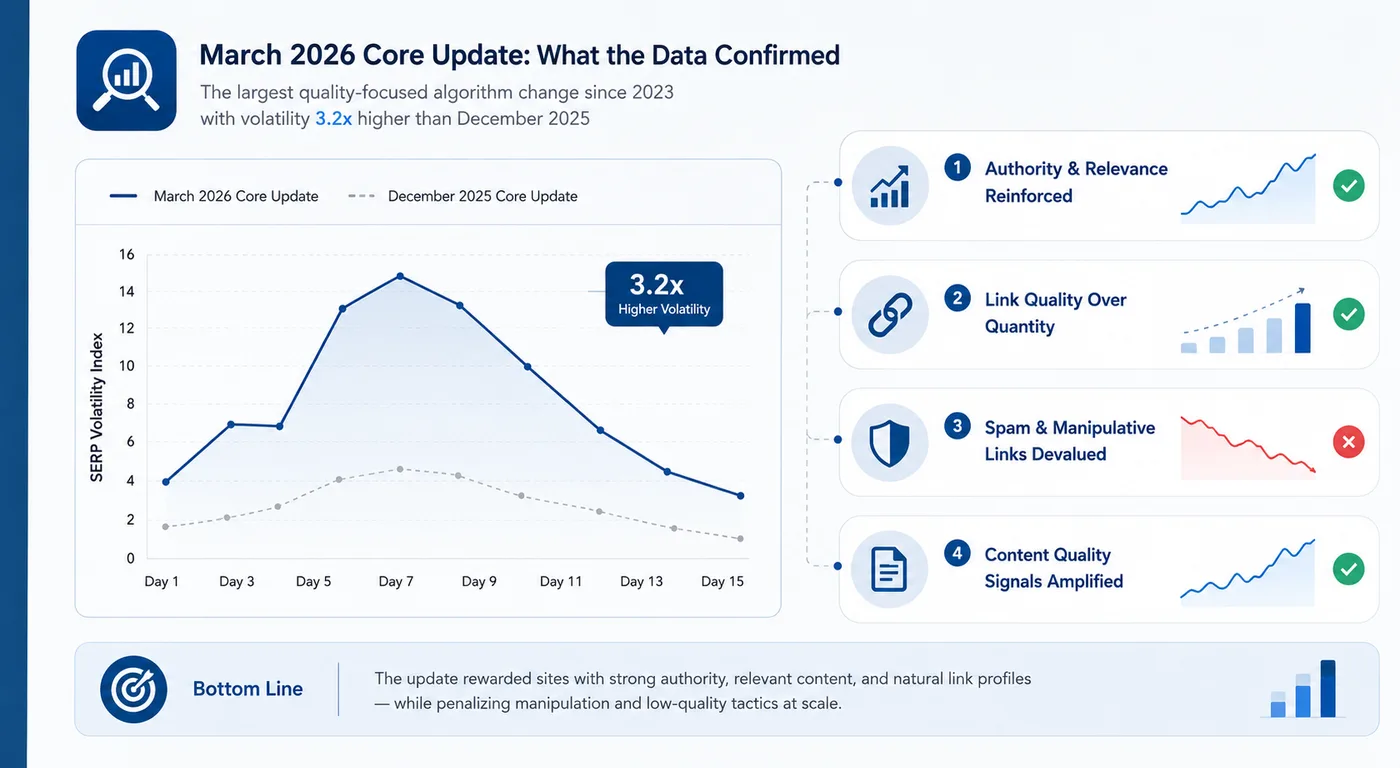
The March 2026 core update — the biggest quality-focused change since 2023, with 3.2x the volatility of December 2025 — validated four things the correlation data already showed:
- Sites publishing AI content with no human editing lost 30–55% of organic clicks during the 30-day window.
- Sites with named-author bylines using Person schema and sameAs links gained about 14% in clicks.
- Sites with 12–30 supporting articles per cluster gained on thin competitors running 1–3.
- Sites with mobile INP under 200ms gained on mobile; those above 200ms slipped.
In Germany, SISTRIX counted four losers for every winner — 134 confirmed losses against 32 gains — and the winners skewed heavily toward official sites, established brands with real brand search, and niche publishers with genuine depth.
Part 2: What works in 2026
2.1 Topical authority and content clusters — the biggest on-page lever
Surfer SEO's analysis of 253,800 results found page-level topical authority is the largest on-page factor in 2026 — it outweighs the host domain's monthly traffic. In plain terms: a new site with deep coverage can beat an older site with thin coverage on the same query. 88% of SEOs now rate topical authority "very important."
The numbers behind clusters:
- 25–30 interlinked articles in one cluster: a 40–70% keyword lift within 3–6 months.
- 16+ supporting pages per topic: an average +9.4 position lift vs. zero supporting pages.
- Prioritizing topical depth produces gains 3.7x faster than chasing domain authority alone.
- One B2B case: 12 articles a month on a single theme drove a 429% traffic lift in a year.
The correlation study backs it: cluster depth tracks target-page rank at 0.45, internal linking depth at 0.38, and pages with fewer than 3 internal inbound links sit at −0.21 — held back no matter how strong their external links are. The architecture that works: a 2,500–4,000-word pillar; 1,200–2,000-word supporting pages; every supporting page links to the pillar and back, siblings cross-linking where it's relevant; and roughly 25–30 articles per core topic to hit the tipping point.
2.2 E-E-A-T — a ranking signal now, not a guideline
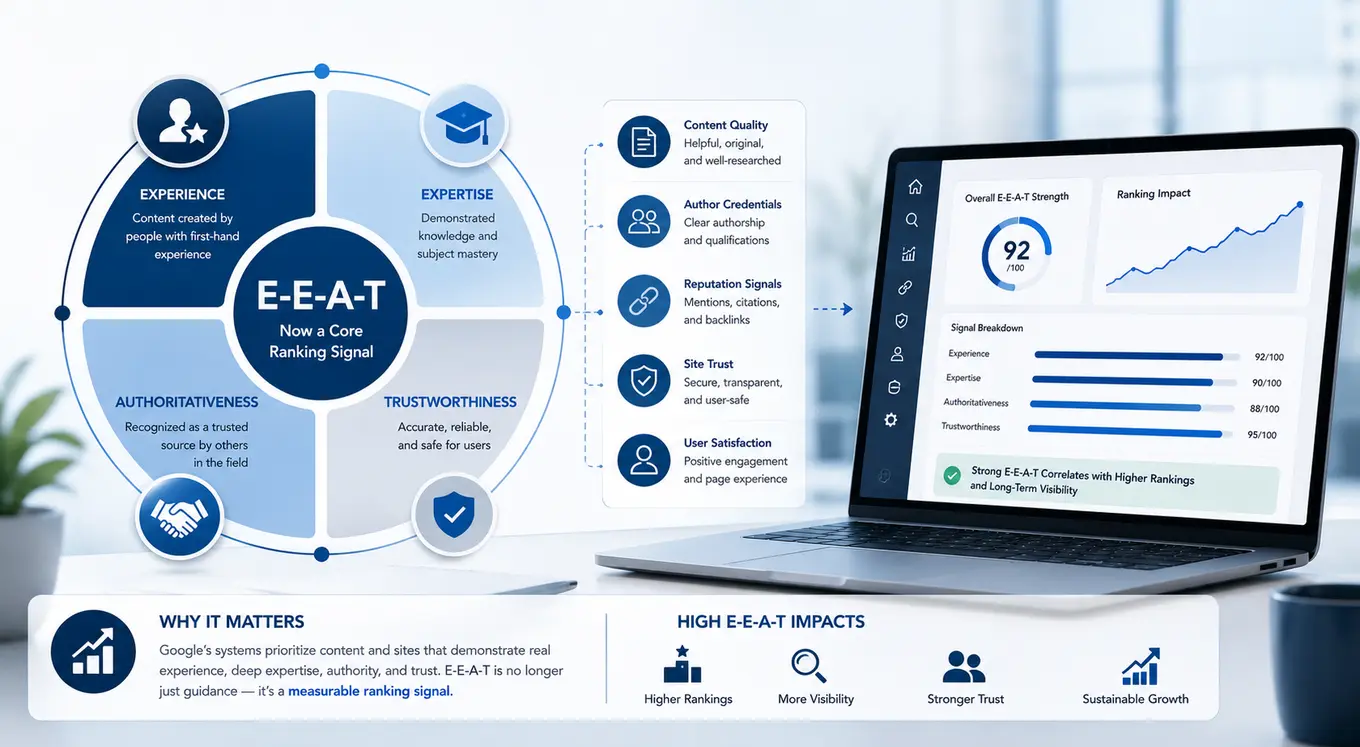
E-E-A-T weight has doubled since 2018. Author authority correlates at 0.42 globally and 0.61–0.68 in YMYL (health, finance, legal). In YMYL, pages without a named author, bio, and sameAs links rank 7.4 positions lower on average than pages with the full set.
The 2022 shift from E-A-T to E-E-A-T — adding Experience — is the crux. Google now rewards content where the author shows first-hand experience, and that's exactly what a generalist or an AI can't credibly fake about a medical procedure, a legal matter, or a product they've actually used. It's the specific axis unedited AI content keeps failing. The minimum implementation the 100,000-page study ties to rank gains:
- A named byline on every article (not "Staff" or "Admin")
- A full bio with credentials, qualifications, and prior work
- Author schema with sameAs links to LinkedIn, ORCID, or a professional registry
- Inline citations to primary sources throughout
- A visible last-updated date
- A real transparency/contact page with real people
- For YMYL: reviewer credentials for health/medical, disclaimers for legal
2.3 Schema — the fastest-growing signal
Schema's correlation with rank has tripled since 2018, from 0.14 to 0.41 (composite) — one of the fastest climbs in the study. Two forces drive it: Google leans on structured data for both rich results and AI Overview citation, and LLM-spun content rarely ships complete, accurate schema, so it doubles as an authenticity tell.
| Schema Type | Correlation | Primary Use |
|---|---|---|
| FAQ schema | 0.51 | AI Overview citation, SERP FAQ feature |
| HowTo schema | 0.48 | Tutorial rich results |
| Article + Author schema | 0.40 | E-E-A-T signals, AIO citation |
| Schema completeness composite | 0.41 | Overall AI extractability |
| Product + AggregateRating | 0.44 | E-commerce rich snippets |
| Organization + sameAs | — | Entity resolution, AI citation |
Pages with the full stack (FAQ + HowTo + Article + Author) rank about 12.2 positions higher than pages with none. FAQ schema alone makes a page 38% more likely to win an AI Overview citation and 27% more likely to land the People Also Ask feature. The catch that trips people up: schema does nothing if the underlying content is thin. It's the machine-readable layer on top of quality — not a substitute for it.
2.4 Backlinks — still #1, with a higher floor
Referring domains (0.74) and Domain Rating (0.68) are still the two strongest individual factors. Backlinks correlate roughly 85% more strongly with rank than in 2018 — the AI-content flood of 2023–2025 pushed Google to lean harder on established authority as a counterweight.
| Target Rank | Median Referring Domains | Top Quartile RDs |
|---|---|---|
| Position 1 | 312 | 1,840 |
| Position 2–3 | 184 | 720 |
| Position 4–5 | 97 | 348 |
| Position 6–10 | 41 | 148 |
| Position 11–20 | 18 | 72 |
It's non-linear: once a page passes ~150 referring domains in its niche, extra links deliver sharply less. And speed kills — more than 200 new referring domains in 30 days carries a 38% chance of a manual or algorithmic review. The winning pace is boring and consistent: 5–15 new referring domains a month, compounding over 12+ months. Digital PR is the standout tactic (34–48% of practitioners call it their best) because a single editorial placement gives you a followed link for classic SEO and a brand mention for AI citation.
2.5 Depth beats length
Content depth correlates at 0.62 — third overall. Raw word count? Just 0.18. The "longer wins" rule from 2015–2020 is dead. A tight 1,200-word piece that fully covers its topic beats a 4,000-word one padded with filler.
| Rank | Median Word Count | Median Depth Score | Depth Percentile |
|---|---|---|---|
| 1 | 2,140 | 87/100 | 92nd |
| 2–3 | 1,860 | 78/100 | 84th |
| 4–5 | 1,540 | 64/100 | 67th |
| 6–10 | 1,180 | 41/100 | 42nd |
| 11–20 | 940 | 22/100 | 19th |
Depth here means semantic richness × sub-topic completeness × entity coverage — not word count. Top-decile-depth pages rank ~4.2 positions above median. To actually get there: answer the primary intent before anything else, cover the surrounding entities and concepts (not just keywords), add original data or frameworks AI can't summarize into existence, structure headings around real questions, and show first-hand experience.
2.6 Core Web Vitals — the speed differentiator
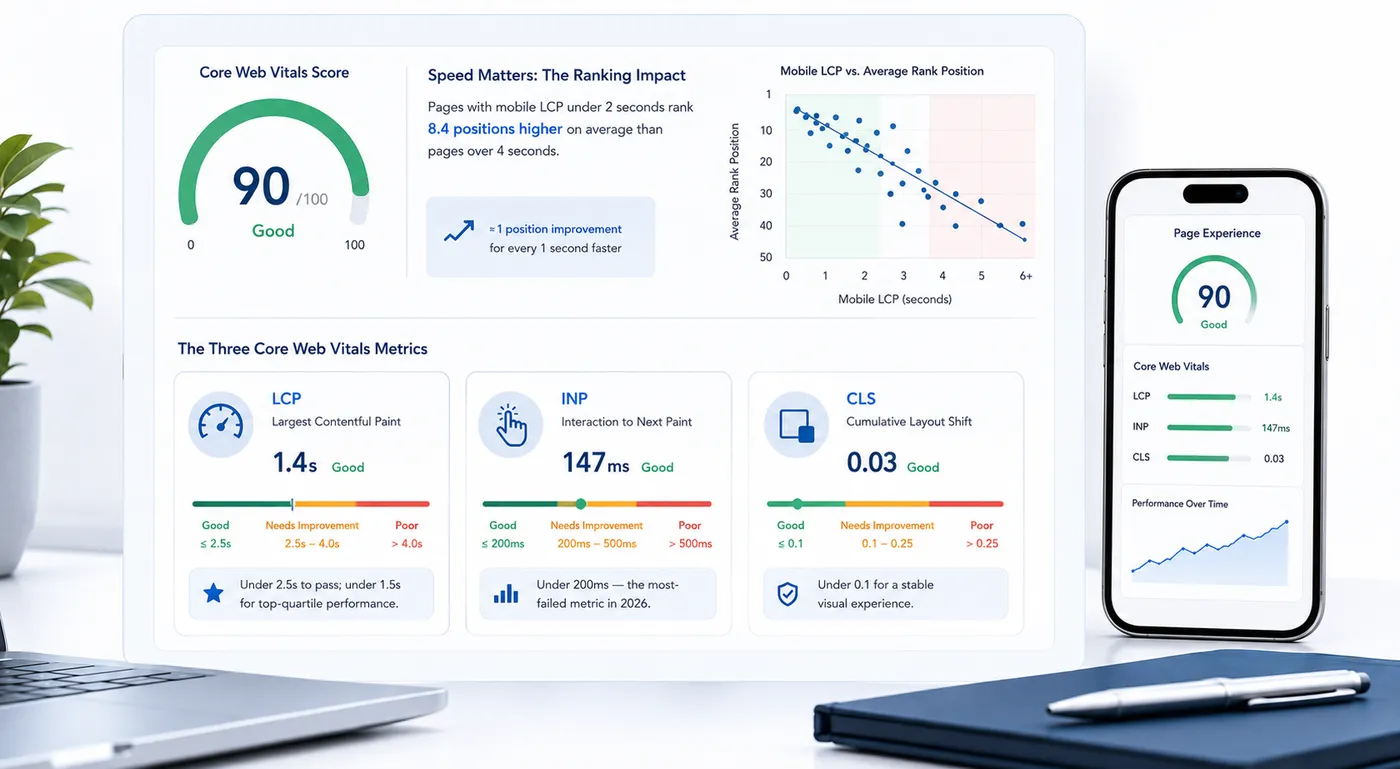
CWV are confirmed signals; LCP correlates at 0.48. Pages with mobile LCP under 2 seconds rank 8.4 positions higher on average than pages over 4 seconds — roughly one position per second of improvement. The three targets:
- LCP: under 2.5s to pass; under 1.5s for top-quartile
- INP (replaced FID in 2024): under 200ms — the most-failed metric in 2026
- CLS: under 0.1
INP is the one to understand. It measures how fast the page reacts to taps, clicks, and keystrokes, and it's a JavaScript problem, not a server one. Mobile pages that fail INP see 35% shorter sessions, which drags the engagement signals Google reads indirectly. Fixing INP was one of the three signals that predicted who gained in March 2026. And the money angle: a 1-second LCP delay costs 7% of conversions (Google/Deloitte), while sites passing all three CWV see 24% lower bounce — which compounds into better dwell time and steadier rankings.
2.7 AI search optimization (AEO + GEO) — the new required layer
With 58–68% of searches ending click-free and AI Overviews on 48% of queries, optimizing for the AI answer is table stakes now. Two frameworks: AEO (answer-engine optimization for snippets and AI extraction) and GEO (getting cited in ChatGPT, Perplexity, Gemini). The key stat, from Ahrefs' 75,000-brand study: brand mentions correlate with AI visibility at r = 0.664 versus just r = 0.218 for backlinks. These engines read editorial consensus, not link graphs — so every editorial placement pays twice.
The AI Overview citation factors the 12,400-query sub-study surfaced:
- Definitive H2 opener (0.49): each H2 followed by a 1–2 sentence standalone answer an LLM can lift verbatim — these pages are 2.4x more likely to be cited
- Citation density per 100 words (0.42): frequent inline citations to stats and named sources win more citations
- Schema completeness (0.41): Article + FAQ + HowTo + Author wins AIO citations 1.6x more often
- Author authority (0.39): named authors with sameAs and visible credentials get preferred
- Table and list density (0.36): structured blocks parse better than walls of prose
Pages cited in an AI Overview see a 23% lift in branded search over the next 30 days even when the direct click-through is negligible — which makes AIO citation the highest-leverage objective in informational categories. One silent killer to check: a robots.txt (or default Cloudflare config) that blocks GPTBot, OAI-SearchBot, PerplexityBot, ClaudeBot, or Google-Extended wipes out AI citation eligibility entirely.
2.8 Freshness — critical for YMYL, minor elsewhere
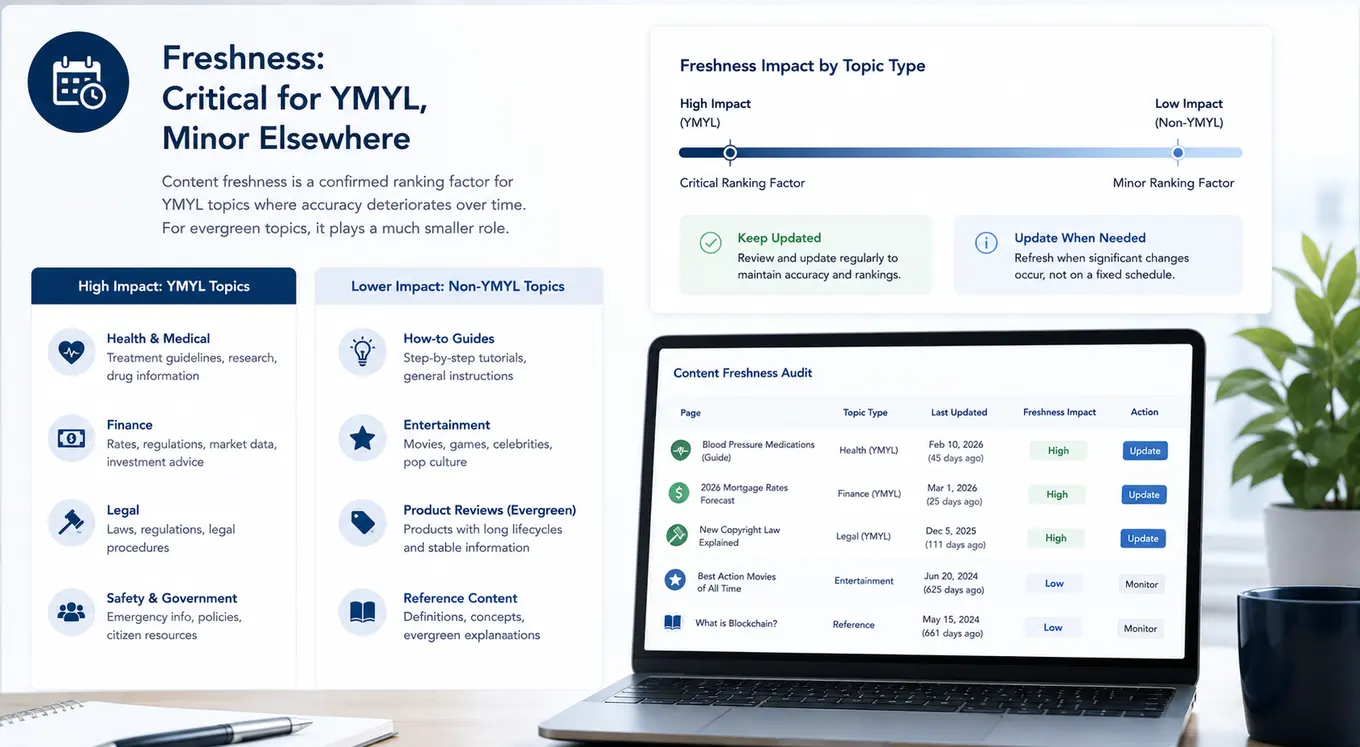
Freshness is highly sector-specific. In YMYL, pages updated within 90 days outrank older ones by 4.7 positions and the freshness correlation hits 0.62 — a top-3 factor there. In evergreen categories it collapses to 0.07. Review high-traffic pages every 90 days, informational blogs every 6–12 months, and refresh to fix "reality drift" (stale stats, prices, product details, regulations) rather than restyling. Content older than ~10 months starts losing ground in AI citation systems. Refresh triggers worth watching: a 20%+ ranking drop with no obvious update cause, data more than 12–18 months old, a competitor page from the last 6 months out-depthing you, no extractable answer in the first 60 words, or no FAQ/structured Q&A.
2.9 Engagement signals — the hidden quality filter
Engagement is measurably in the model now: CTR from SERP at 0.43, dwell time at 0.38, and pogo-sticking at −0.41 (the strongest negative signal measured).
| Rank | Median CTR | Median Dwell Time | Pogo-stick Rate |
|---|---|---|---|
| 1 | 27.6% | 142s | 8.4% |
| 2–3 | 14.7% | 118s | 12.1% |
| 4–5 | 8.6% | 94s | 16.8% |
| 6–10 | 4.2% | 71s | 22.4% |
| 11–20 | 1.8% | 48s | 31.2% |
Dwell over 90 seconds ranks measurably better than under 30; higher-than-expected CTR for a position lifts it over 60–90 days; pogo-sticking above 25% triggers demotion in 3–6 weeks. Cutting pogo-sticking is one of the highest-ROI moves you can make: front-load the answer in the first 50 words, match intent exactly, get LCP under 2 seconds, and make sure the page delivers what the title promised.
2.10 Local SEO — Google Business Profile is the lever
For local-services queries, aggregate review rating + count is the top factor at 0.74 — higher than any single factor in any sector. Proximity sits at 0.68, GBP completeness at 0.62. Priorities: fill every GBP field and pick the precise primary category; treat review velocity as more important than total count; keep reviews recent; manage the Q&A section; post at least weekly; and keep name/address/phone consistent across every citation.
Part 3: What doesn't work in 2026
72% of sites that lost meaningful traffic in 2025–2026 were running at least 10 outdated tactics. They cluster into five buckets.
3.1 Unedited AI content — the top traffic killer
AI content with no human editing, no first-hand experience, and no editorial owner is the leading cause of ranking loss in 2026 — sites doing it at volume lost 30–55% of organic clicks in the March 2026 window. Google's stance, folded into core ranking after August 2025: AI content isn't penalized for being AI; it's penalized for being low-quality, unhelpful, and manipulative at scale. Mass generation into publish pipelines — pages that repeat one intent, make unverifiable claims, and add nothing beyond rephrased SERP summaries — trips the Helpful Content System's site-wide penalty, which drags down even the good pages on the same domain. What keeps AI-assisted content alive through updates: human review of every factual claim, a real "differentiation layer" per page (a proprietary benchmark, screenshot, framework, or observed case), real author bylines, and one dominant intent per URL. Programmatic doorway pages, unattributed spun content, and template-overfit pages are all "scaled content abuse" — a named target of the 2025–2026 spam updates.
3.2 Volume link building — neutralized and penalized
The three tactics with the widest gap between how much they're used and how little they return:
- Reciprocal link exchanges: 43.8% adoption, 0% "best method" votes, −0.18 correlation. It actively harms.
- Forum-signature and comment links: −0.31 and −0.22 — among the strongest negatives in the study. Disavowing them often produces immediate recovery.
- Bulk guest posting on weak publishers: sites where more than 30% of content is guest posts get their outbound link value cut; only 18% of practitioners rate guest posting their best method despite 42.4% using it.
The January and March 2026 spam updates went straight at "link insertions at scale," PBNs, and expired-domain schemes. SpamBrain catches PBNs with near-certainty, and the 19.5-hour March rollout signaled a pre-trained model, not a fresh system.
3.3 Keyword theater — negative returns
Plenty of things people still optimize sit at zero or below:
- Keyword density: −0.21 at the over-optimization threshold
- Exact-match domains: −0.34 (actively penalized)
- Word count past 1,000: 0.18 (padding adds nothing)
- Title-tag keyword tuning beyond the basics: 0.06 (everyone does it, so no edge)
- Meta descriptions: not a ranking factor — CTR only
Keyword stuffing anywhere — intros, headings, meta, anchors — reads as a negative quality signal. Google's language models match entities and meaning, not frequency. Write for semantic coverage and you get better rankings and better engagement.
3.4 Technical-audit over-indexing
A big chunk of SEO budget gets burned fixing audit "errors" that change nothing. Tools routinely flag 50–100 issues on a healthy site; roughly 95% are cosmetic. The issues that genuinely block rankings are short: pages blocked in robots.txt (including accidental AI-crawler blocking), stray noindex tags, misconfigured canonicals creating mass duplication, 5xx errors, and missing HTTPS (now pure hygiene — 99.4% of top-10 pages already have it). Things tools flag that don't matter: title tags a few characters long, missing favicons, short meta descriptions, code-to-text warnings, correctly-functioning redirects, missing image dimensions. The real technical wins in 2026 are INP (a JavaScript audit), AI-crawler access, schema for AI citation, and crawl budget on large sites.
3.5 Chasing rank on AI-intercepted queries
Position-1 CTR is down 58% on AI Overview queries, and 93% of AI Mode queries end with zero external clicks (Seer, 25.1M impressions). But brands cited inside the Overview pull 35% more organic and 91% more paid clicks at the same position. So grinding for position 1 on heavily intercepted informational queries without also optimizing for citation is wasted effort — the objective moved from "rank #1" to "get cited." Traditional ranking still pays in full on navigational, brand, specific commercial, local, and purchase-intent queries.
Part 4: Sector-specific factor weights
Factor weights swing by up to 2.4x across sectors. A global baseline is useful, but the real work is sector-specific:
| Sector | Top Factor | 2nd Factor | 3rd Factor |
|---|---|---|---|
| YMYL — Health | Author authority (0.68) | Content freshness (0.64) | Schema (0.58) |
| YMYL — Finance | Author authority (0.66) | Content freshness (0.62) | Brand mentions (0.58) |
| YMYL — Legal | Author authority (0.61) | Content freshness (0.60) | Backlinks (0.58) |
| Local services | Aggregate review (0.74) | Proximity (0.68) | GBP completeness (0.62) |
| B2B SaaS | Content depth (0.78) | Topical authority (0.62) | Backlinks (0.58) |
| E-commerce | Page speed / LCP (0.62) | Review rating (0.68) | Schema completeness (0.58) |
| Travel | Aggregate review (0.62) | Image pack inclusion (0.48) | Page speed (0.46) |
| Education | Content depth (0.68) | Author authority (0.54) | Topical authority (0.46) |
| Manufacturing | Backlinks (0.71) | Content depth (0.54) | Schema (0.42) |
For iGaming and gambling — squarely relevant to affiliate publishers — the sector is YMYL, so author authority, freshness, and editorial E-E-A-T carry elevated weight. Gambling affiliate content without named experts holding verifiable credentials gets suppressed the same way medical content without medical authors does.
Part 5: The algorithm cadence
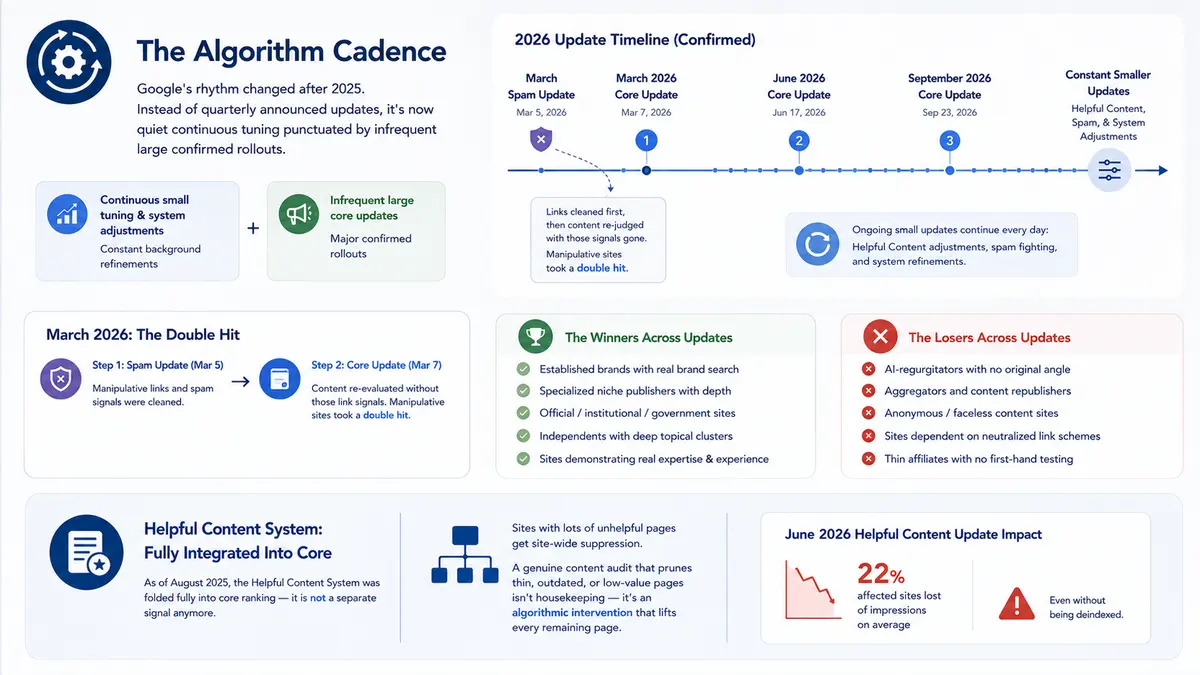
Google's rhythm changed after 2025. Instead of quarterly announced updates, it's now quiet continuous tuning punctuated by infrequent large confirmed rollouts. 2026 has seen three confirmed core updates (March, June, September — the latter two still settling at time of writing) plus constant smaller Helpful Content and spam adjustments. The March core update trailed the March spam update by two days — links cleaned first, then content re-judged with those signals gone, so manipulative sites took a double hit.
The winners across updates: established brands with real brand search, specialized niche publishers with depth, official/institutional sites, and independents with deep clusters. The losers: AI-regurgitators with no original angle, aggregators, anonymous content, sites dependent on now-neutralized link schemes, and thin affiliates with no first-hand testing.
One structural change to internalize: the Helpful Content System was folded fully into core ranking in August 2025 — it's not a separate signal anymore. Sites with lots of unhelpful pages get site-wide suppression, so a genuine content audit that prunes thin/outdated pages isn't housekeeping, it's an algorithmic intervention that lifts every remaining page. The June 2026 Helpful Content update hit AI-written pages especially hard — affected sites lost 22% of impressions on average even without being deindexed.
Part 6: The zero-click reality — and what to do about it
58–68% of searches now end without a click; on AI Overview queries that jumps to 80–83%. Position-1 CTR is down 58% year over year on those queries. This is the biggest structural change to organic economics in Google's history. The answer isn't to quit SEO — it's to change the target:
- From: maximize click-through from position 1
- To: maximize brand visibility inside AI Overviews, plus traditional clicks on commercial-intent queries where interception is low
Traditional ranking still delivers full click value on navigational/branded queries, purchase-ready transactional queries ("buy," "pricing," "book"), local intent, long-tail specifics the AIO doesn't fully answer, and complex technical queries. And because AIO citation lifts branded search 23% within 30 days, AI optimization isn't a replacement for SEO — it's an amplifier of it.
Part 7: The 2026 priority hierarchy
Where to put your effort, in order, based on the correlation data, update outcomes, and practitioner evidence:
Tier 1 — Foundational authority (do first)
- Topical clusters: build 25–30-article clusters around core topics — the single biggest on-page lever
- E-E-A-T: named authors, full bios, Author schema with sameAs on every article
- Editorial backlinks: digital PR and selective guest posting at 5–15 new referring domains a month
- AI-crawler access: audit robots.txt and Cloudflare so GPTBot, PerplexityBot, and ClaudeBot aren't blocked
Tier 2 — Technical and content quality (essential maintenance)
- INP: fix JavaScript execution on key pages — the most-failed CWV metric
- LCP: target under 2.5s; every second earned is roughly a position
- Depth audits: find pages in the 19th–42nd depth percentile and deepen their entity and sub-topic coverage
- Pogo-sticking: fix high-exit pages — front-load answers, correct intent mismatches
Tier 3 — AI optimization (competitive edge)
- AIO formatting: rework pillars with definitive H2 openers, citation density, and self-contained section answers
- FAQ schema everywhere you answer questions — the highest-correlation schema type
- HowTo schema on tutorials and instructions
- Brand-mention amplification: build presence on AI-cited platforms (Reddit, YouTube, Wikipedia, LinkedIn long-form, review sites)
Tier 4 — The stop-doing list (eliminate now)
- Unedited AI content at scale
- Link-exchange programs (0% best-performer votes; −0.18)
- Forum and comment-section links (−0.31, −0.22)
- Exact-match anchor campaigns (Penguin flag above ~5%)
- PBNs and expired-domain schemes (SpamBrain catches both)
- Technical remediation beyond the five real blockers
- Word-count padding with no added depth
- Anonymous "team author" bylines on YMYL content
The through-line for 2026: authority, depth, and genuine expertise compound; volume and manipulation decay. Build for the reader and for the engines that increasingly read like one, and the rankings — and the AI citations — follow.