
The short version
Let's kill the "are backlinks dead?" debate up front: they're not. But if you're still running the 2020 playbook, you're lighting money on fire. In the last 18 months the ground shifted harder than it did in the previous five years, and three things drove it. Google's SpamBrain got good enough to quietly switch off manipulative links the moment it sees them. AI search — AI Overviews, ChatGPT, Perplexity, Gemini — became how a huge chunk of people actually find things, and it rewards a different signal set entirely (brand mentions beat links roughly 3 to 1). And the people who do this for a living moved upmarket fast: 76% now pay $300+ per link and 64% spend over $3,000 a month.
Here's the honest read after digging through the 2026 data. Links are still a top-three Google ranking factor, they still track closely with organic traffic, and 94% of us think they'll still matter in five years. What changed is the how. The tactics that used to work are now either invisible (SpamBrain ignores them) or dangerous (PBNs, link farms, guest-post mills). What still moves the needle is a short list done well: digital PR, content-led outreach, tightly targeted guest posts, and turning brand mentions into links — earned from relevant sources at a pace that doesn't look engineered.
Part 1: Where backlinks actually stand in 2026
Do they still work? Yes — with a catch
The #1 result on Google carries 3.8x more backlinks than positions #2–#10 (Backlinko, 11.8 million results). A page with at least one backlink is 77% more likely to crack the top 10. Content, page experience, and links are still the top three factors, and 78.1% of SEOs report positive ROI on link building. So the "yes" isn't really in question.
The catch is that the quality bar shot up while the number of tactics that clear it shrank. The market has split in two: a thin layer of genuinely editorial, high-authority, on-topic links that actually shift rankings — and a vast ocean of junk that SpamBrain throws straight in the bin. Most of the industry is still fishing in the junk pool while paying prices meant for the good one.
From ranking hack to authority signal
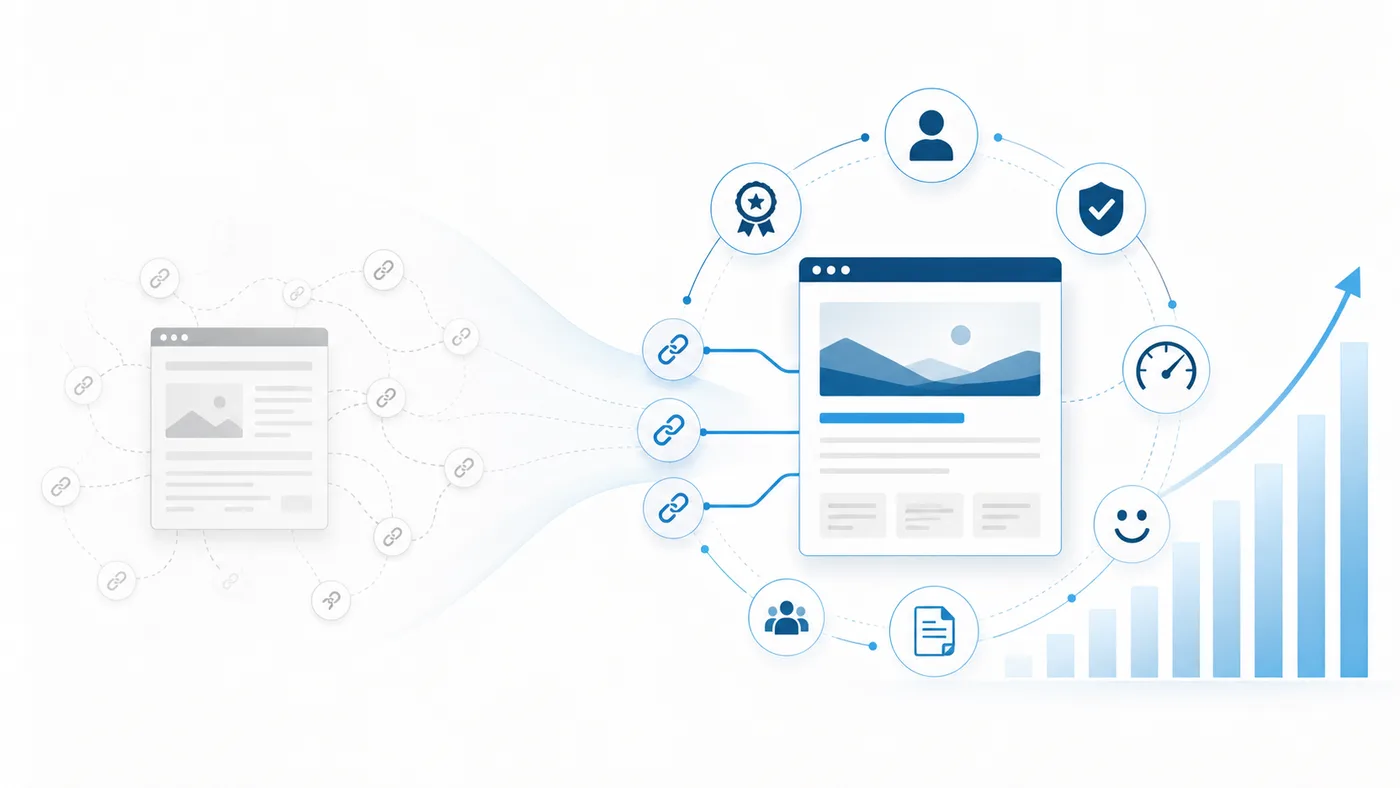
Backlinks stopped being a volume game a while ago. Piling them up no longer converts mechanically into rankings. Think of them now as amplifiers inside a bigger trust system — Google weighs relevance, E-E-A-T, page experience, and brand reputation right alongside your link profile. A weak site can't buy its way up with links; a strong one can widen its lead with them.
Yes, Gary Illyes said links "haven't been in the top three for some time" and that Google needs "very few links to rank pages," and half the industry panicked. But rankings still correlate strongly with referring domains, 92.3% of the top 100 ranking sites have at least one backlink, and PageRank still treats links as votes. Read Illyes as a shot at volume-obsessed link building, not a eulogy — which lines up with 58% of teams raising their link budgets this year.
What the people spending the money actually say
The Reporter Outreach State of Link Building 2026 (500 practitioners) is the cleanest snapshot we have:
| Metric | 2026 Figure |
|---|---|
| SEOs who increased link building budget | 58% |
| Monthly spend $3,000+ | 64% |
| Maximum willingness to pay per link | 76% pay $300+ |
| Largest single budget segment | $500–$1,000 per link (31%) |
| Prioritize quality over quantity | 62% |
| Still chasing volume | 9% |
| Expect prices to rise further | 75% |
The verdict is in: budgets are up, per-link prices have climbed 20–40% since 2022, and the room has decisively chosen quality. The cheap-and-bulk end of the market is down to about 6% of buyers.
Part 2: How AI search rewired the strategy
A different kind of search
AI Overviews now fire on roughly 48% of Google searches (Q1 2026), up from 31% a year earlier, in front of 2 billion people a month across 200+ countries. Google's AI Mode passed 100 million monthly users. ChatGPT, Perplexity, and Gemini soak up hundreds of millions of queries that used to hit classic search. McKinsey found 44% of AI-search users now treat AI as their primary research tool.
Why should a link builder care? Because these systems don't read the link graph the way Googlebot does. They read the editorial consensus of the open web — who's talking about you, where, and in what context.
The brand-mention finding that should change your roadmap
Ahrefs looked at 75,000 brands across AI Overviews, ChatGPT, and AI Mode and found the stat I've been quoting in every strategy deck since: branded web mentions correlate with AI visibility at r = 0.664, while backlink count sits at just r = 0.218. Mentions are roughly three times more predictive of getting cited by AI than links are. Domain Rating came in at r = 0.326; raw content volume was basically noise at r = 0.194.
A December 2025 follow-up went further — YouTube mentions turned out to be the single strongest correlator across all three platforms at r ≈ 0.737, edging out even web mentions. Brands in the top quartile for mentions averaged 169 AI Overview appearances; the next quartile down averaged fourteen. That's not a gap, it's a cliff.
| Signal | Google AI Overviews | ChatGPT | AI Mode |
|---|---|---|---|
| YouTube mentions | ~0.737 | ~0.737 | ~0.737 |
| Branded web mentions | 0.664 | 0.656 | 0.709 |
| Branded anchors | 0.527 | 0.511 | 0.628 |
| Branded search volume | 0.392 | 0.352 | 0.466 |
| Domain Rating | ~0.326 | 0.266 | higher |
| Backlinks (count) | 0.218 | weak | moderate |
| Content volume | ~0.194 | ~0.194 | ~0.194 |
Practically: a link from a strong domain still matters, but the mention wrapped around it — your brand named in an article the AI engines crawl — may do more for AI visibility than the link. Every good editorial placement now pays twice: a link for classic SEO, a mention for AI.
Everybody knows, almost nobody's acting
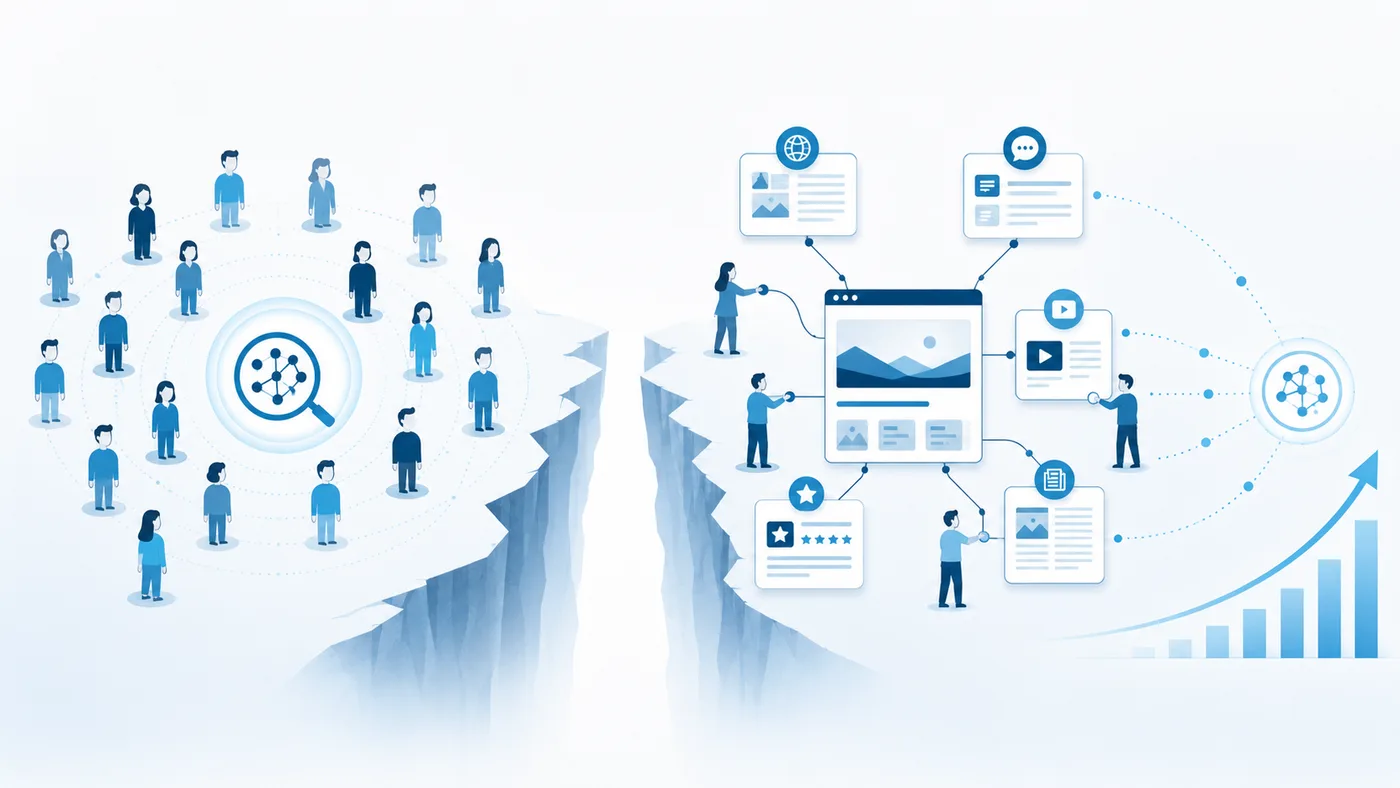
74% of practitioners say backlinks influence AI visibility, yet only 24% track it and just 19% have changed how they build links because of it. That gap is the biggest open lane in link building right now. The brands seeding mentions across the places AI trusts — Wikipedia, Reddit, YouTube, G2, the real press — are quietly building a citation footprint these engines will lean on for years.
Where the engines actually pull from
Profound mapped 30 million AI citations, and the source preferences are not interchangeable:
| Platform | Top Cited Sources |
|---|---|
| ChatGPT | Wikipedia (47.9%), Reddit (21.0%), Forbes (6.8%) |
| Perplexity | Reddit (46.7%), YouTube (13.9%), Gartner (7.0%) |
| Google AI Overviews | Reddit (11.3%), YouTube (18.8%), Quora (14.3%) |
Translation: pointing every link at your own homepage isn't enough anymore. You need presence on the platforms each engine already trusts. And they barely overlap — only 11% of the domains ChatGPT cites also show up in Perplexity — so "an AI strategy" is really several.
What AI Overviews do to your clicks
They don't just move authority around — they quietly drain traffic from anyone not inside them. Position-1 organic CTR is down 58% on AI Overview queries versus non-AI ones (Ahrefs, Feb 2026), nearly double the 34.5% drop from April 2025. Seer Interactive found 93% of AI Mode queries ended with zero clicks out. The upside: get cited inside the Overview and you pull 35% more organic clicks and 91% more paid clicks than uncited brands at the same position. Being in the box is the whole game.
Part 3: SpamBrain and the 2026 updates
It neutralizes — it doesn't always punish
Here's the part most people still get wrong about SpamBrain. For the vast majority of manipulative links, it doesn't hand you a penalty. It just stops counting the link and quietly pulls back whatever boost you were getting. Neutralize, not penalize.
That changes the whole calculus. When a spam update rolls through, the pain isn't a punishment you can appeal — it's a withdrawal. Cleaning up the links afterward won't bring the rankings back; you simply land where you'd have been if you'd never built them, minus the time and cash. Which is exactly why the disavow tool does nothing for algorithmically neutralized links, and why leaning on it usually backfires by stripping out links that were actually helping.
The 2026 sequence
This year made SpamBrain's maturity impossible to miss. The January 2026 link spam update hit an estimated 4.2% of English queries — bigger than past link updates — rolled out over three weeks, and brought in proportional devaluation (links lose value in proportion to their spam score instead of being zeroed out) plus domain-level trust scoring.
Then the March 2026 update wrapped in 19.5 hours — the fastest spam update Google's ever shipped, 34x quicker than the 27-day August 2025 one. That speed tells you something: this was a pre-trained model being switched on, not a new system being built. Google already knew the targets; enforcement was basically instant.
A broad core update landed three days later (March 27), and the order was deliberate — clean the link signals first, then re-judge content quality with those signals gone. Sites propped up by manipulative links took the hit twice. Affiliate sites in gambling and finance saw 55–70% of their traffic evaporate.
The 27-day August 2025 update had already gone after the same list — scaled content abuse, cheap link schemes, PBNs — which tells you Google reruns the same playbook rather than inventing new categories each time.
What it's actually reading
Four signal families give link manipulation away:
- Velocity — how fast new referring domains show up, tracked over as much as 24 months. Spikes with no matching content or press event get flagged.
- Anchor text — exact-match commercial anchors above ~5% of the profile read as manipulation, and it's judged across the whole profile, not link by link.
- Network footprints — shared hosting, shared owners, cookie-cutter site templates, clusters all pointing at the same targets.
- Relevance — whether links sit on topically connected pages, or turn up in a language/geo that makes no sense for the target.
Links from thin, duplicated, or AI-spun pages now get extra scrutiny no matter how authoritative the domain looks overall. And PBNs are getting caught with uncomfortable accuracy — including ones on separate servers with separately registered domains.
Disavow is the emergency brake, not the steering wheel
Treat disavow as a genuine last resort: use it for an active manual action, or when you know you built manipulative links and a penalty feels imminent. Worth noting that Bing scrapped its disavow tool entirely back in 2023 because its spam detection made it pointless — a decent tell for where Google's headed.
The mistake I see constantly is people using third-party "toxicity scores" from Ahrefs or Semrush as a disavow trigger. Those are vendor metrics, not Google signals. SpamBrain already ignores the truly bad links, so disavowing them does nothing — and disavowing borderline ones just throws away links that were quietly working for you.
Part 4: What's actually working in 2026
Digital PR — the clear winner
34% of practitioners in the Reporter Outreach survey name digital PR their single best method — nearly double guest posting at 18%. A separate Aira/Editorial.link survey of 518 pros put it even higher at 48.6%, more than triple anything else. Two surveys, same answer. That's about as settled as this industry gets.
It wins because it pays twice, exactly like we said: a followed editorial link from a strong domain and a branded mention feeding your AI signals. The average campaign pulls links from 42 unique referring domains at an average DR of 61, and 85.2% show measurable results in 3–6 months.
| Asset Type | Average Link Lift |
|---|---|
| Original research / surveys | +200% more links than standard content |
| Free tools and calculators | +94% vs static content |
| Statistics / data roundup pages | +180% |
| Long-form guides (3,000+ words) | 3.5x more links than short content |
| Industry annual reports | Compounding (cited every year) |
| Infographics | +12% content traffic |
One data-driven PR push can land 15–20 editorial links at DR 70+ — the kind of authority you simply can't buy through guest posts or niche edits at any price.
Guest posting — still useful, clearly fading
It's still the most-used tactic (64.9% of link builders per Authority Hacker), but the effort-to-payoff ratio has slipped. Only 18% call it their best method, and the gap between how much it's used and how well it works keeps widening as fees rise and editors tighten up.
It does still work when you're picky. 90% of accepted guest posts land on same-niche sites, and 85.3% of marketplace guest-post sites flunk basic quality checks (DR < 40, or under 10,000 monthly organic visitors). The formula that holds up: DR 40–70, real organic traffic, a relevant audience, and an editor who actually makes you write something worth reading.
What should get an opportunity crossed off your list:
- Sites that publish anything from anyone (guest-post farms)
- High DR but little to no organic traffic
- More than 30% of the content is guest posts
- Over-optimized or shady outbound link patterns
- Spun or mass AI-generated content
HARO / journalist sourcing — top authority, near-zero cost
46.3% of link builders use HARO (Connectively) regularly, and folded in with digital PR, PR-style tactics are the "best method" for 55% of pros. The draw is obvious: a sharp HARO answer can land you in Forbes, The Guardian, or Wired for free — links you can't transact for at any budget.
To win here in 2026: reply inside 1–2 hours, answer the actual question instead of pitching yourself, bring a real data point or a contrarian angle, and keep it to 150–250 words. 60.7% of PR folks say finding the right journalist is harder than a year ago, and 73% of journalists bin pitches as off-beat — so relevance and speed are the whole skill.
Niche edits — fast and effective, but on notice
A niche edit drops your link into an already-published article somewhere else. Runs about $361 a placement, and it often carries more weight than a fresh guest post because the host page is already indexed, ranking, and pulling its own links.
The January 2026 update called out "link insertions at scale" by name. That doesn't ban niche edits — it puts a target on volume, low-standard programs. A few careful, on-topic insertions in genuinely ranking pages from real publishers is a completely different animal from buying 50+ a month off a marketplace.
Broken link building — the best conversion rate in outreach
This one converts better than almost anything because you're solving a problem, not asking a favor. Find 404s on strong sites in your niche, figure out what used to live there, build a better version, and offer it. It's especially strong for established sites with enough content to slot in as replacements. Quick tool tip: Ahrefs' "Best by Links" filtered to 404s hands you a pre-qualified list of dead pages that still have 10+ referring domains.
Unlinked mention reclamation — the easy win everyone skips
80.9% of SEOs see ranking value in unlinked brand mentions, but the real reason to chase them is conversion: someone already decided you were worth naming, so the hard part's done — turning it into a link converts close to 100% on active sites. Watch for them with Ahrefs Alerts, Google Alerts, or Semrush Brand Monitoring.
It's also the highest-ROI move for AI visibility. Turning a mention into a link on a site the AI engines already cite gives you the traditional backlink and reinforces the mention signal that topped Ahrefs' correlation study at r = 0.664.
Competitor link-gap analysis — where every campaign should start
54% of businesses now build links off competitor gap analysis: find the strong domains linking to rivals but not to you, then go get them with better content. Ahrefs' Link Intersect spits out that list directly. One caveat from the data, though — 66.6% of experts say finding unique opportunities beats copying competitors. Use the gap list as a warm starting point, not the whole plan. Original research, first-party data, and free tools pull links no competitor has earned yet, which is where the real separation happens.
Part 5: Quality, metrics, and targeting
The DR sweet spot
Best value in 2026 sits at DR 40–60, where 53% of practitioners focus. High enough to actually move rankings, cheap enough to scale, and relevant enough to dodge the link-farm swamp that clogs the DR 10–30 tier.
The filters that matter most:
- DR minimum: 91% set one; 52% require DR 50+
- Organic traffic: the linking page needs real traffic — the 2024 API leak analysis confirmed links from zero-traffic pages are basically worthless
- Topical relevance: 87.2% rank relevance as the #1 quality factor
- Editorial integrity: original content, and standards that make getting in non-trivial
DR 70+ links show 42% faster keyword growth, but you generally only reach them through digital PR, not transactional outreach — and premium placements run $700–$2,000+ each.
Anchor text
What a natural profile looks like, and what to hold to:
| Anchor Type | Natural Share | Risk Threshold |
|---|---|---|
| Branded | 50–60% | No upper risk |
| Naked URL | 10–15% | No upper risk |
| Generic ("click here," "read more") | 15–20% | No upper risk |
| Partial-match / semantic | ~10% | Watch above 15% |
| Exact-match commercial | Under 5% | Penguin flag above ~5–8% |
Over-optimized exact-match anchors are a top-five cause of manual penalties, and profiles above 15% exact-match are far more likely to get flagged. The 2026 SpamBrain reads anchor distribution across your whole profile, so it catches unnatural patterns even when each individual link looks fine. If you're over-optimized, the fix is simple and boring: stop building exact-match anchors and let fresh branded and generic links dilute the ratio. Don't touch disavow unless there's a manual action.
Velocity
5–15 new referring domains a month is the sane range for most sites, scaled to size. Natural growth tracks real events — a launch, some press, a partnership. Hundreds of links in a week with nothing behind them is a textbook SpamBrain trigger, and with velocity now analyzed over 24 months, short build-and-pause bursts are easier to spot than ever. Steady wins: consistent acquisition over 12+ months delivers 4.2x more ranking improvement than the same links crammed into a short burst.
Nofollow in 2026
78.8% of SEOs think nofollow links affect rankings — so much for the old "zero value" line. Google's treated nofollow as a hint, not a directive, since 2019, so they can still count. More to the point, nofollow links from busy pages send real referral traffic, feed the brand-mention signals AI reads, and keep your follow/nofollow ratio looking natural. In Semrush's AI study, nofollow and dofollow performed almost identically for AI visibility (0.340 vs 0.341) — for AI citations, the rel attribute basically doesn't matter.
Part 6: What it costs in 2026
Budgets
The whole market moved upmarket. From the Reporter Outreach survey of 500 pros:
| Monthly Budget Range | Share of Market |
|---|---|
| Under $1,000 | 12% |
| $1,000–$3,000 | 24% |
| $3,000–$6,000 | 26% |
| $6,000–$12,000 | 21% |
| $12,000+ | 17% |
64% spend $3,000+ a month, and agencies now put 32.1% of total SEO budget into links — the biggest single line item, ahead of content and technical. To compete in the hard niches, Editorial.link pegs the realistic floor at $8,406/month.
Cost per link
Fair market for a genuinely good link is about $508.95 (Editorial.link, 518 pros). By DR tier:
| DR Range | Direct Placement | Via Vendor |
|---|---|---|
| DR 20–39 | $130–$220 | $300–$450 |
| DR 40–59 | $220–$400 | $450–$800 |
| DR 60–69 | $400–$700 | $800–$1,500 |
| DR 70+ | $700–$1,200+ | $1,500–$3,800+ |
| Forbes / premium press | $3,000+ | $5,000+ |
Treat anything under $300 as a quality or relevance risk. Publisher fees are up 20–40% in two years and 75% of us expect them to keep climbing — so if you can lock in relationships and access at today's rates, do it, because next year's entry price will be higher.
Outreach math
Cold reply rates have cratered from 8.5% in 2019 to 3.43% in 2026 (Instantly). Email-to-link sits at 3–5% for good programs, and only 8.5% of cold emails produce a link end to end. What actually helps:
- Personalized subject lines: +30.5% open rate
- Personalized bodies: +32.7% response rate
- One follow-up: +65.8% total replies (a single follow-up roughly doubles responses)
- Spray-and-pray (>1,000 emails): ~0.85% reply rate — 3x worse than targeted small batches
- Tuesdays and Thursdays open best
- 100–200 words is the sweet spot
Personalize with AI but send by hand and you get roughly 3x the efficiency with no real hit to reply rate. Full automation at scale just trips spam filters and drops you to that ~0.85% floor.
Part 7: Playing each AI platform
There's no single "AI strategy"
ChatGPT and Perplexity share only 11% of cited domains, and even Google's own AI Overviews and AI Mode overlap on just 13.7% of URLs. One generic approach can't win everywhere — each platform needs its own presence.
| Platform | Primary Citation Sources | Key Strategy |
|---|---|---|
| ChatGPT | Wikipedia (47.9%), Reddit, Forbes | Wikipedia presence, Reddit participation, editorial press |
| Perplexity | Reddit (46.7%), YouTube, Gartner | Reddit, YouTube reviews, B2B directories |
| Google AI Overviews | YouTube (18.8%), Reddit, Quora | YouTube, structured content, Overview optimization |
| Google AI Mode | Branded signals strongest (0.709) | Brand building, branded search volume, branded anchors |
The citation targets worth prioritizing
Beyond classic editorial links, Profound's work points to the ecosystem LLMs cite most:
- Wikipedia / Wikidata — a Wikidata entry correlates with 2.8x higher citation odds across assistants
- Reddit — the most-cited UGC platform across all three major engines
- YouTube — the single strongest individual correlator with AI visibility (r = 0.737)
- G2 / Capterra / Trustpilot — for B2B, G2 is the most-cited domain for buying-intent queries in ChatGPT (First Page Sage, 36,000 queries)
- LinkedIn — long-form articles jumped from rank 11 to 5 on ChatGPT in three months
- Editorial press — the majors already baked into training data
What Princeton found about getting cited
Princeton's GEO paper (Aggarwal et al., KDD '24) tested which content changes lift AI citation rates:
- Adding citations and statistics lifts AI visibility by up to 40%
- Adding credible sources alone gave a 115% visibility bump for a #5-ranked page
- Structured, citable, data-backed content is over-represented in AI citations
The neat part: the exact content that ranks in Google and earns editorial links — data-rich, well-sourced, structured, authoritative — is the same content AI engines love to quote. You're not building two things.
Part 8: Building a profile that survives the next update
The 10-point checklist
A profile that shrugs off algorithm updates hits all ten:
- Exact-match commercial anchors under ~5%
- Branded + URL anchors are the majority (50%+)
- New-domain velocity tracks real content and PR (no unexplained spikes)
- No PBNs, expired-domain plays, or bulk insertions
- Links are topically relevant to the niche
- A diverse mix — not one tactic, geo, or link type
- Paid/incentivized links properly marked sponsored/nofollow
- Quarterly audits as routine
- Disavow reserved for manual actions or known self-built spam
- Most new links are asset-led and editorially earned
Clear all ten and you don't just survive updates — you tend to gain when competitors on manipulative links get reset. March 2026 proved it: 24% of analyzed sites gained, 35% lost, and the winners were overwhelmingly the ones that had built real authority.
One program for Google and AI
Optimizing for rankings and for AI citation isn't two jobs — it's one:
- Digital PR earns editorial links and brand mentions at the same time
- Original data and research pulls links and gets quoted inside AI answers
- YouTube is now the strongest single correlator with AI visibility
- Wikipedia / Wikidata builds AI citation infrastructure independent of rankings
- Review platforms (G2, Capterra, Trustpilot) feed the B2B AI citation pool
The principle to run everything through: any placement on a high-authority, AI-indexed domain gives you a link for SEO and a mention for AI. Aim your acquisition at domains the engines already cite, and every link does double duty.
If you've already been hit
Recovery sequence for a profile caught by the 2025–2026 updates:
- Confirm the cause against known update windows, and let the rollout finish before you touch anything
- Run a full audit — velocity, anchors, relevance, footprints
- Stop the manipulative acquisition immediately; ending the pattern comes first
- Disavow only if there's a manual action — otherwise put the energy into earning replacements
- Rebuild with linkable assets, digital PR, and relevant content
- Watch Search Console over 3–6 months; algorithmic recovery is gradual, not a switch
Recovering from a neutralized boost really means rebuilding on an earned footing. Those rankings were borrowed; the job now is to earn equivalent authority the legitimate way — usually the same 3–6 months it takes to build the first time.
Part 9: What to stop doing
The fastest ways to waste budget or invite trouble in 2026:
| Tactic | Risk in 2026 | Why |
|---|---|---|
| Private Blog Networks (PBNs) | Very High | SpamBrain catches them almost every time; March 2026 targeted PBN networks directly |
| Bulk niche edits | High | Flagged in the January 2026 update; the patterns are detectable |
| Exact-match anchor campaigns | High | Profile-level anchor analysis; >5% exact-match gets flagged |
| Guest-post farms | High | High-volume acceptors get identified and their outbound value cut |
| Link exchanges / reciprocal links | Very Low ROI | 43.8% use it; 0% call it their best |
| Expired-domain schemes | High | Specifically targeted in March 2026 |
| Translated / spun networks | High | Cross-referenced and devalued by SpamBrain |
| Links from AI-spun content pages | High | Extra scrutiny regardless of DR |
| Mass templated outreach | Very Low ROI | <1% reply rate and increasingly spam-filtered |
The reciprocal-link number says it all: 43.8% of SEOs still do link exchanges and exactly 0% named it their best tactic. Nothing else in the survey had a wider gap between how much it's used and how little it works.
Part 10: Where this is going
The next few years
94% of SEOs expect links to still be a ranking factor in five years, 73% in ten. The consensus isn't that links fade — it's that how they're judged keeps evolving:
- Detection keeps getting sharper — Google gets better at telling earned from placed, however natural it looks
- Entity-based evaluation grows — links judged by the brands and people behind them, not just the domain
- Cross-platform signals count more — social, podcasts, YouTube, and other brand signals feed into link value
- Evaluation goes real-time — link values adjust continuously instead of in batch updates
The brands that come out ahead through the next cycle are already building genuine authority — press mentions, YouTube, Wikipedia/Wikidata, review profiles, and steady original research that gets cited in both search and AI. That's not a tactic you bolt on; it's a posture that makes the next SpamBrain update a non-event.
The budget picture
75% expect costs to keep rising, and the supply-demand math backs them up: publisher fees climb every year, quality inventory is finite, and demand from both traditional SEO and AI programs is growing at once. Build authority at 2026 rates and you're locking in relationships that'll cost materially more to establish in 2027. Authority compounds — links you earn today keep passing value while new domains stack on top — so early beats delayed. The market already knows it: 58% raised their 2026 budget, and the fastest-growing tier is $6,000–$12,000 a month.